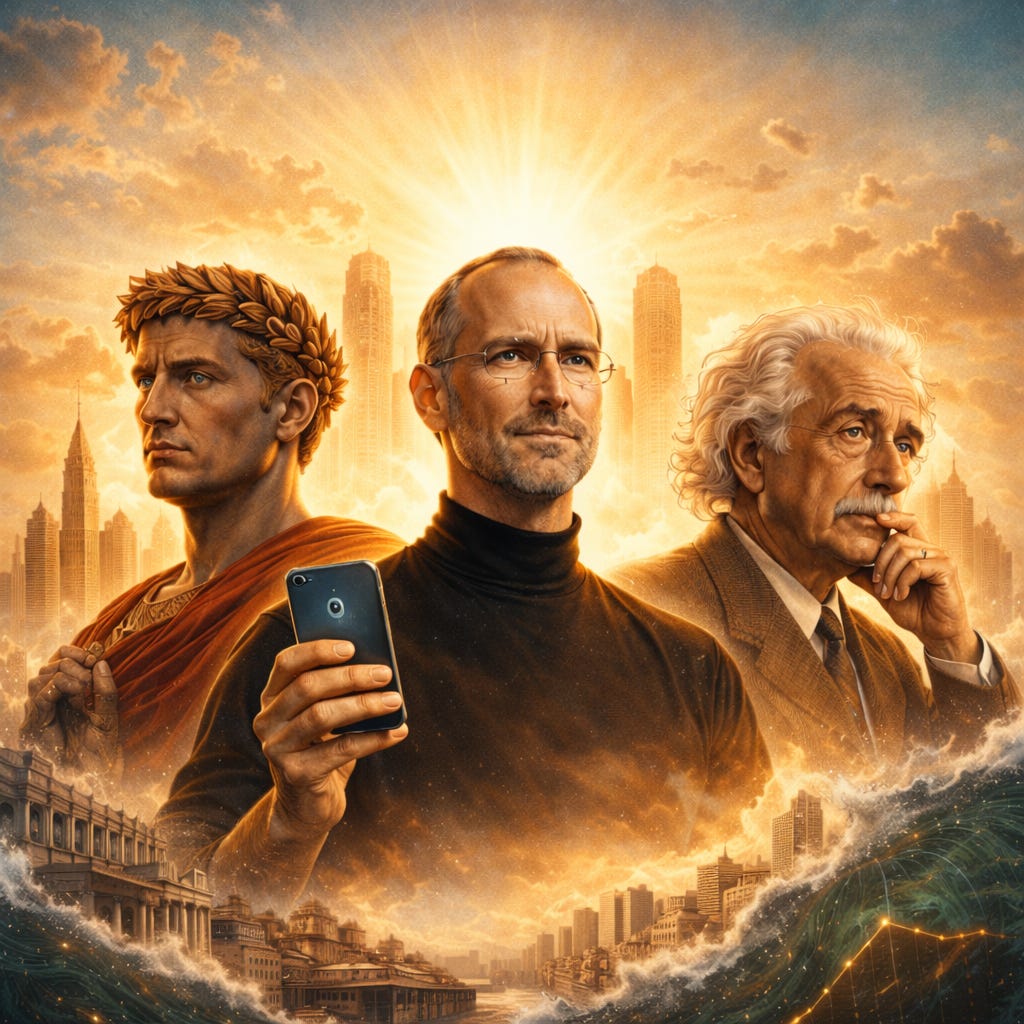
Humans worship extraordinary individuals. The ones worthy of lasting memory. The ones who will be remembered.
Einstein. Jobs. Bonaparte. Curie.
They are all legends. World changers. History writers. Or at least we like to think so. Because it connects to a deeper mindset, to our ego. If they changed the world, maybe we can too.
Their stories inspire. You work harder. Grind more.
If you’ve tried everything and growth still isn’t happening, there’s probably one blind spot hiding in plain sight. Our team knows exactly where to look. We’re selecting 10 Founder Marketer readers for a free 20-minute executive review.
You’ll receive a senior-led audit + custom action plan built to get your numbers moving again.
That is the essence of the Great Man Theory. Originating from the historian Thomas Carlyle, this school of thought argues that history is the product of extraordinary individuals.
Caesar shaped Rome, thus changing history.
Einstein shaped modern physics, thus changing history.
Bonaparte shaped European politics, thus changing history.
This theory is very much loved by the public. I guess simplifying history into individuals eases our anxiety. Whether we praise someone or blame them, we assign responsibility to a select few. History is driven by genius, willpower, charisma, and leadership. In that sense, we assume business works the same way.
Except it doesn’t.
If only the world were that simple. Or so Fernand Braudel argues. Enter the structuralist response.
Long Duration & World-Systems
Braudel, a French historian, argued that history is shaped by deep structural forces — geography, climate, trade routes, and demographics. In short, what he called longue durée (long duration).
According to Braudel, individuals exist on the surface, while structures operate underneath. The Roman system was the ocean. Caesar was the wave.
Another theory close to this one is Wallerstein’s World-Systems Theory. According to Immanuel Wallerstein, the world operates as a system: core, semi-periphery, and periphery. This means systems create the conditions for genius.
I’m inclined to think this way as well. But how does all this theoretical info dump connect?
I call this Critical Threshold Theory.
Structures, culture, knowledge accumulate. Then, at a breaking point, someone becomes the “Great Man”.
Structural energy builds > Tension accumulates > A catalytic individual triggers the release.
The work of dozens of thinkers — from Newton to Maxwell — laid the groundwork. Einstein triggered the rupture.
The individual is not the origin. He or she is the ignition point. So how does this circle back to business?
Well, we love the great founder myth. Steve Jobs. Elon Musk. Jeff Bezos.
But let’s look at one example.
The iPhone required several things to happen first:
Semiconductor maturity
Globalized Chinese manufacturing
A venture capital ecosystem
Mobile internet infrastructure
These fundamentals matured, and an individual leveraged them.
Think about the marketing success stories you often hear:
“This ad campaign transformed the category.”
“That founder’s storytelling changed the industry.”
“This brand won because of genius positioning.”
Now, these can all be true. Most likely they are true. But marketing genius usually works only when the category is structurally ready.
You can’t position your way out of a structurally dead market. You can’t brand your way into a non-existent demand curve. You can’t storytell your way through bad timing.
Categories emerge before heroes.
Luxury DTC brands? Needed Instagram distribution, cheap Facebook ads (2014–2018), globalized supply chains, improved Chinese manufacturing, and consumer fatigue with legacy brands.
Crypto? Needed zero interest rates, liquidity cycles, and the COVID-era retail speculation wave.
AI? Needed GPU supply, transformer breakthroughs, and cloud infrastructure maturity.
You get the point.
So how can we theorize this in a way that founders can actually use?
The structural layers of marketing success:
1. Slow Layer: Deep structural changes you cannot hack.
Demographic shifts
Technological maturity
Capital availability
Distribution channels
Regulation
Cultural shifts
2. Cyclical Layer: Mid-term dynamics where growth opportunities appear.
Ad platform arbitrage (Meta, YouTube, TikTok)
Cost of capital
Media fragmentation
Consumer sentiment cycles
3. Event Layer: The founder and campaign layer — the one we see, talk about, and analyze.
A great ad
A viral moment
A charismatic CEO
Why does this matter?
Because if you only believe in the Great Man Theory, you might learn the wrong lesson. You should first analyze structural forces: timing, capital cycles, distribution shifts, and regulatory changes. Only then should you think about founder execution: copy, branding, storytelling, and charisma.
If you only see what is above the water, you will copy visible tactics without replicating invisible conditions.
If you try to do exactly what Gymshark did, copy Apple’s branding, or recreate Shopify, you might fail — because those conditions no longer exist.
Cheap Facebook ads are gone.
Zero interest rates are gone.
Organic reach is mostly gone.
The structure has moved. And so should you.
If you misattribute success to individuals instead of structures, you will systematically misallocate capital, time, and ambition.
Economics and history moved on from the Great Man Theory long ago. But business culture is still stuck in 19th-century hero worship.
Think of business opportunities as a box. As a founder or executive, your task is to choose the box, not simply optimize inside it.
When you study “how X won,” you are studying a frozen outcome. By the time you copy them, the structure has already changed. Tactical imitation is almost always structurally late.
On a more personal note, believing too strongly in the Great Man Theory can also create unnecessary anxiety.
You start telling yourself:
“If I just become better, I’ll win.”
“If I hustle harder, I’ll break the market.”
But sometimes the truth is simpler: it may just be the wrong time for what you’re trying to do.